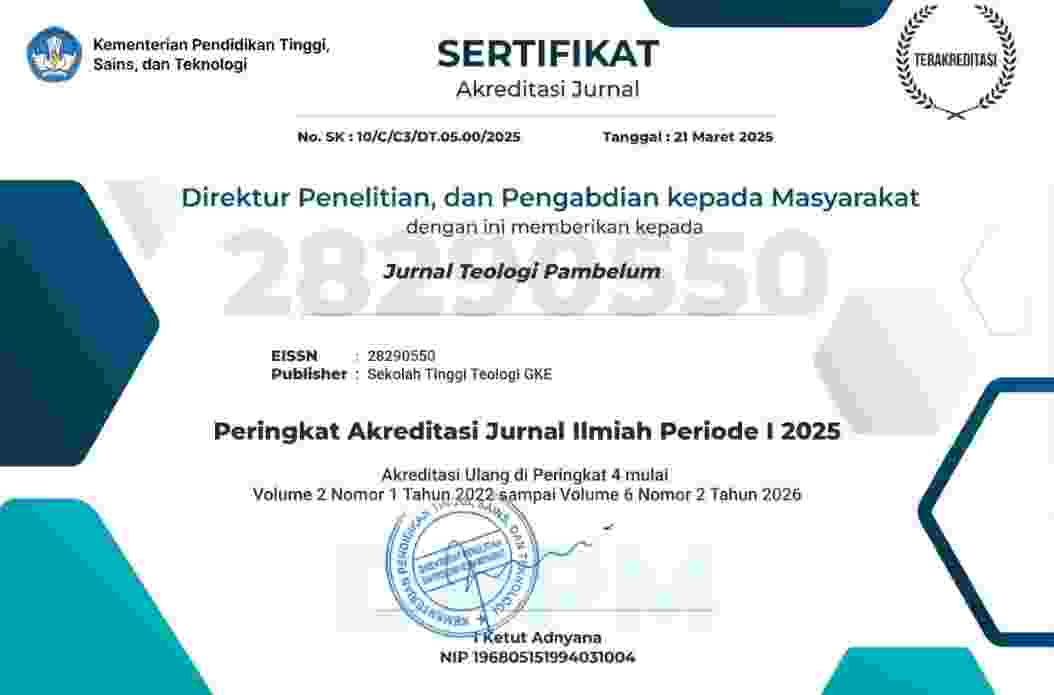
Acreditation Base on Surat Keputusan Direktur Jenderal Riset dan Pengembangan Nomor 10/C/C3/DT.05.00/2025
Jurnal Teologi Pambelum is committed to maintaining academic integrity and ensuring that all submitted and published articles meet established standards of research ethics and scholarly publication. Plagiarism and other forms of research misconduct are unacceptable. The journal reserves the right to conduct investigations, request clarification, and take appropriate action whenever suspected violations are identified.
Plagiarism includes, but is not limited to, the following practices:
Using or quoting words, phrases, sentences, data, or information from other sources without proper citation or adequate acknowledgment.
Copying part or all of another person's work, either verbatim or with minor modifications, without appropriate quotation and acknowledgment of the original source.
Using another person's ideas, opinions, perspectives, or theories without properly acknowledging the original source.
Paraphrasing or reformulating words, sentences, ideas, opinions, perspectives, or theories from other sources without providing adequate attribution.
Presenting scholarly work produced or published by another person as one's own without proper acknowledgment.
Reusing one's own previously published work without appropriate citation or disclosure when such reuse constitutes self-plagiarism or redundant publication.
In addition to plagiarism, Jurnal Teologi Pambelum does not tolerate the following forms of research misconduct:
Data fabrication: Inventing data, findings, or research results that were never actually obtained.
Data falsification: Manipulating research materials, processes, data, or results so that the research record no longer accurately reflects what occurred.
Data manipulation or misrepresentation: Improperly altering, omitting, or presenting data and findings in ways that lead to misleading interpretations.
Duplicate or redundant publication: Publishing or submitting substantially the same work more than once without the necessary disclosure and approval.
Authorship violations: Listing individuals who do not meet the authorship criteria, excluding individuals who do meet those criteria, or providing inaccurate information about authors' contributions.
Citation manipulation: Including irrelevant references or manipulating citations to inappropriately increase citation counts.
Research ethics violations: Failing to comply with applicable ethical approval requirements or protections for research participants when such requirements apply to the research conducted.
All manuscripts submitted to Jurnal Teologi Pambelum may be screened using text similarity detection software. The text similarity index must not exceed 20%. However, the similarity percentage alone does not automatically determine whether plagiarism has occurred. Editors will assess similarity reports by considering the context, identified sources, accuracy of citations, direct quotations, reference lists, and other relevant factors.
Authors are responsible for ensuring that submitted manuscripts are original, that all sources are properly acknowledged, that data and findings are presented honestly, and that all research processes are reported accurately. Authors must also comply with applicable research ethics requirements and the journal's other policies, including its authorship criteria and artificial intelligence (AI) policy.
If problematic passages or indications of research integrity violations are identified, editors may request clarification, supporting documentation, or revisions from the authors before making further decisions.
When plagiarism or other research miscondust are suspected, editors will examine the available evidence and, where necessary, request clarification from the authors before determining the appropriate course of action.
Actions that Jurnal Teologi Pambelum may take include:
Requesting that authors correct citations, quotations, source attributions, or other problematic parts of the manuscript.
Issuing a formal reprimand or written warning to the authors.
Rejecting a manuscript that is under review or in the publication process.
Withdrawing or retracting a published article if a serious violation is established.
Taking other appropriate editorial actions in accordance with the severity of the violation and applicable publication ethics standards.
The appropriate action will be determined based on the nature, severity, and impact of the suspected research misconduct, the available evidence, and the stage of the publication process at which it is identified. Jurnal Teologi Pambelum is committed to handling all allegations of research misconduct fairly, objectively, proportionately, and consistently.



Beriman, Berilmu, dan Berdampak
SEKOLAH TINGGI TEOLOGI GEREJA KALIMANTAN EVANGELIS
Jl. D.I. Panjaitan No. 11 Banjarmasin, Kalimantan Selatan, Indonesia 70114
Website Jurnal: http://jurnal.stt-gke.ac.id/index.php/pambelumjtp
Email: ojspambelum@gmail.com
 Karya ini dilisensikan di bawah Lisensi Internasional Creative Commons Atribusi-NonKomersial-BerbagiSerupa 4.0
