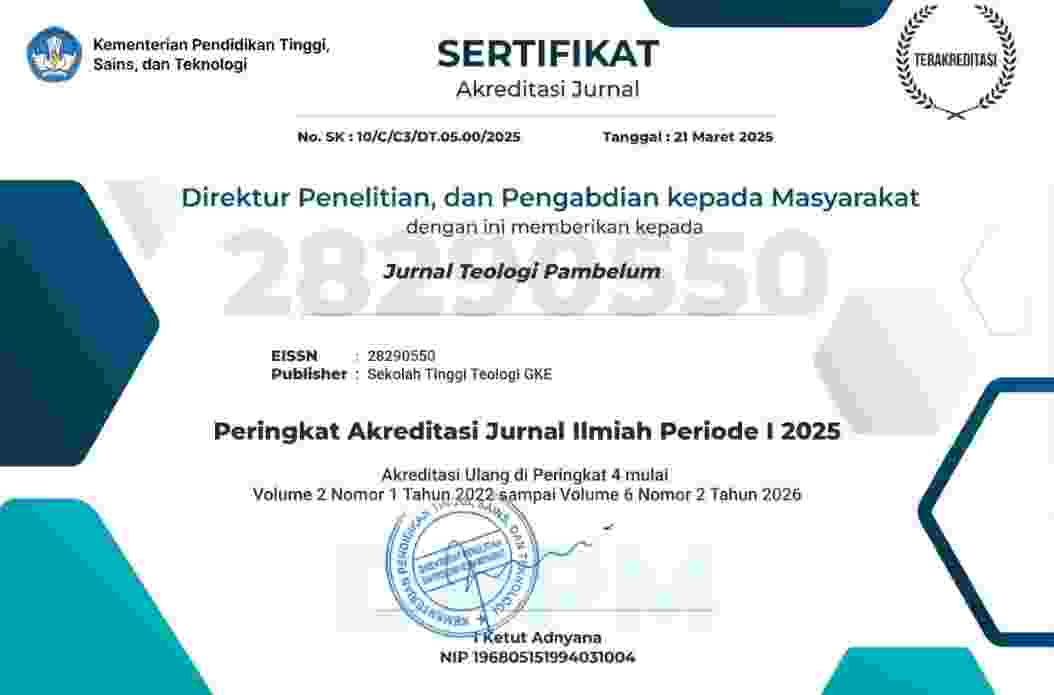
Acreditation Base on Surat Keputusan Direktur Jenderal Riset dan Pengembangan Nomor 10/C/C3/DT.05.00/2025
Type of Peer Review
Jurnal Teologi Pambelum employs a double-blind peer-review process, in which the identities of authors and reviewers are kept confidential throughout the review process. Authors do not know the identities of the reviewers, and reviewers do not know the identities of the authors.
________________________________________________________________________________________________________________________________
Pre-Review
All submitted manuscripts undergo a pre-review assessment by the editorial team before being sent to reviewers. This assessment evaluates the manuscript's suitability for the journal's focus and scope, compliance with the author guidelines, academic writing standards, citation and referencing practices, and adherence to publication ethics.
Authors are responsible for checking the similarity of their manuscripts before submission and must provide a similarity report when requested by the editorial team. In accordance with the journal's Plagiarism Policy, the maximum acceptable similarity index is 20%. The editorial team may examine the submitted similarity report and request further clarification or verification when necessary.
The similarity index alone does not determine whether plagiarism has occurred. The nature and context of textual similarities, the adequacy of citations, and the acknowledgment of sources are taken into consideration. Manuscripts that do not meet the journal's requirements may be returned to the authors for revision or rejected before proceeding to peer review.
________________________________________________________________________________________________________________________________
Reviewer Assignment and Qualifications
Manuscripts that pass the pre-review assessment are assigned to qualified reviewers whose academic expertise is relevant to the subject matter of the manuscript. Reviewers are selected based on their academic expertise, scholarly publication records, and experience in academic writing and research.
Each manuscript is reviewed by at least two qualified reviewers. Reviewers are expected to complete their evaluations within two to three weeks of accepting the review invitation. If a reviewer requires additional time, they must notify the editor as soon as possible and request an extension. Alternatively, the reviewer may recommend a qualified replacement, subject to the editor's approval.
Reviewers registered with Jurnal Teologi Pambelum may submit their own manuscripts to the journal. Such manuscripts must be evaluated by other qualified reviewers, and the submitting reviewer must not participate in the editorial decision concerning their own manuscript.
The Editor-in-Chief may participate in manuscript evaluation when appropriate to their expertise, provided that confidentiality, impartiality, and the avoidance of conflicts of interest are maintained.
________________________________________________________________________________________________________________________________
Review Criteria
Reviewers evaluate manuscripts based on the following criteria:
Reviewers must report suspected plagiarism or other publication ethics concerns to the editorial team for further assessment.
________________________________________________________________________________________________________________________________
Review Procedure and Time Frame
The peer-review process consists of the following stages:
The reviewer evaluation stage is normally expected to be completed within two to three weeks of the reviewer's acceptance of the review invitation. The overall duration of the editorial process may vary depending on reviewer availability, the complexity of the manuscript, the number of revision rounds, and the time required for revisions.
________________________________________________________________________________________________________________________________
Editorial Decisions
Based on the reviewers' recommendations and the editorial assessment, the editorial team may decide to:
The final decision rests with the editorial team. Reviewer recommendations are an important basis for editorial decisions but are not automatically binding.
Revised manuscripts may be returned to the original reviewers for further evaluation. Manuscripts that fail to meet the journal's academic standards or publication ethics requirements may be rejected at any stage of the editorial process.
________________________________________________________________________________________________________________________________
Publication Ethics and Confidentiality
The peer-review process is conducted in accordance with recognized principles of publication ethics, including relevant guidelines of the Committee on Publication Ethics (COPE). The use of artificial intelligence (AI) in manuscript preparation, pre-review, and peer review must comply with the Artificial Intelligence (AI) Guideline.
Editors and reviewers must maintain confidentiality, provide objective and constructive assessments, disclose potential conflicts of interest, and refrain from using unpublished material for personal or professional advantage.
All concerns relating to plagiarism and publication misconduct are handled in accordance with the journal's Plagiarism Policy and applicable publication ethics principles.




Beriman, Berilmu, dan Berdampak
SEKOLAH TINGGI TEOLOGI GEREJA KALIMANTAN EVANGELIS
Jl. D.I. Panjaitan No. 11 Banjarmasin, Kalimantan Selatan, Indonesia 70114
Website: http://jurnal.stt-gke.ac.id/index.php/pambelumjtp
Email: ojspambelum@gmail.com
 This work is licensed under a Lisensi Creative Commons Atribusi 4.0 Internasional
