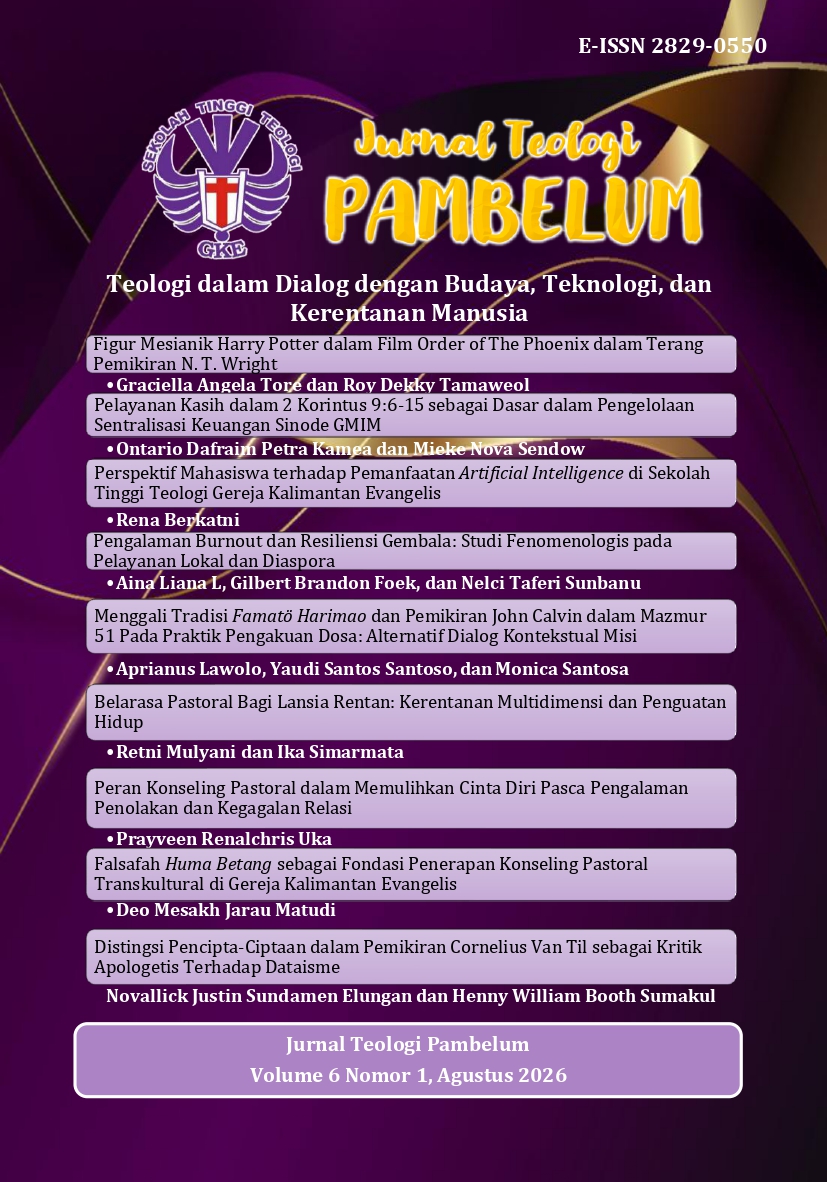
Praise and thanks be to Jesus Christ. With His grace, Jurnal Teologi Pambelum Volume 6, Number 1 (August 2026) is once again published. This edition presents nine articles that illustrating the true dynamics of theology. Theology not only addresses doctrine, but also engages in dialogue with culture, critically examines techological and responds to the experience of human vulnerability.
The first article, “The Messianic Figure of Harry Potter in the Film Order of the Phoenix in the Light of N. T. Wright’s Thought” by Graciella Angela Tore and Roy Dekky Tamaweol, reexamines the character of Harry Potter to demonstrate a significant connection between messianic concepts in theology and portrayals of leadership in popular culture.
The second article, “The Love-Based Ministry in 2 Corinthians 9:6–15 as the Foundation for the GMIM Financial Centralization Management” by Ontario Dafraim Petra Kamea and Mieke Nova Sendow, explores the principle of the ministry of love in 2 Corinthians 9:6–15. Paul’s teaching on giving with joy, willingness, and faith has strong relevance for contemporary church financial management practices, including the management of centralized finances.
The third article, “Students’ Perspectives on the Use of Artificial Intelligence at the Sekolah Tinggi Teologi Gereja Kalimantan Evangelis” by Rena Berkatni, emphasizes that AI is beneficial for learning and ministry, but must be used wisely, ethically, and responsibly without replacing the role of humans or spiritual values.
The fourth article, “Pastors’ Experiences of Burnout and Resilience: A Phenomenological Study of Local and Diaspora Ministry” by Aina Liana L, Gilbert Brandon Foek, and Nelci Taferi Sunbanu, argues that burnout is a multidimensional pastoral disruption, while pastoral resilience is shaped through the interaction of theological, psychological, relational, and organizational resources in accordance with the context of their ministry.
The fifth article, “Exploring the Famatö Harimao Tradition and John Calvin's Thought in Psalm 51 on the Practice of Confession: An Alternative for Contextual Mission Dialogue” by Aprianus Lawolo, Yaudi Santos Santoso, and Monica Santosa, integrates the Famatö Harimao tradition with Psalm 51 to provide a proper understanding of the purpose and meaning of confession within the Famatö Harimao practice.
The sixth article, “Pastoral Care for Vulnerable Elderly: Multidimensional Vulnerability and Life Strengthening” by Retni Mulyani and Ika Simarmata, proposes pastoral care for vulnerable elderly through relational and sustained presence, a dialogical process of meaning-making, and the formation of a responsible community habitus.
The seventh article, “The Role of Pastoral Counseling in Restoring Self-Love After Experiences of Rejection and Relationship Failure” by Ambarwaty Pratiwi I.P. Taturu and Julio Eleazer Nendissa, examines the contribution of pastoral counseling in rebuilding a wounded sense of self through a theological-anthropological approach that affirms human dignity as imago Dei.
The eighth article, “Philosophy of Huma Betang as The Foundation of Transcultural Pastoral Counseling Implementation in Kalimantan Evangelical Church” by Deo Mesakh Jarau Matudi, identifies an organic continuity between the values of huma betang and the principles of transcultural pastoral counseling.
The ninth article, “The Creator-Creation Distinction in the Thought of Cornelius Van Til as an Apologetic Critique of Dataism” by Novallick Justin Sundamen Elungan and Henny William Booth Sumakul examines Dataism’s ontological and epistemological claims regarding reality, humanity, and truth, and then critically evaluates them through the framework of the Creator-creation distinction formulated by Cornelius Van Til.
The articles in this issue as a whole demonstrate that theology is constantly in dialogue with various realities of life. This dialogue takes place through encounters with popular culture and local wisdom, technological developments, church governance, and even experiences of human vulnerability—both in personal life and in ministry. Theology does not remain merely a conceptual discourse but, in a contextual sense, becomes a reflection of faith that helps the church and its congregation understand and respond to the changing times while remaining rooted in God’s Word and respect for human dignity.
This issue is intended to deepen academic reflection, broaden the dialogue between theology, culture, technology, and other disciplines, and strengthen the church’s ministry practices. May the various ideas presented here inspire and encourage the emergence of contextual, responsible, and compassionate ministry amid the dynamics of contemporary life. Enjoy your reading!
Warm regards, Lia Afriliani, M.Th. Editor-in-Chief, Jurnal Teologi Pambelum
Transformative Theology and the Church’s Role in Building an Inclusive, Just, and Sustainable Society
Praise be to the Lord Jesus Christ. By His grace, Jurnal Teologi Pambelum Volume 5, Number 2 (February 2026) has been published. This edition presents nine articles illustrating how Christian theology engages dynamically with social, ecological, digital, cultural, and pastoral realities in an integrative and transformative manner.
The first article, “Urban Society, the Church, and Waste Management: A Theological Review of Urban Planning and Ecological Sustainability in Naikoten I, Kupang” by Esry Wahyuni Beama and Rolin Ferdilianto Sandelgus Taneo, highlights the church’s role in advocating for ecological care amid urban waste challenges.
The second article, “Theological and Spiritual Meaning of the Icon of Christ for Christians in Poso” by Shanti Rualemba and I Gede Supradnyana, explores how the Christ icon serves as a spiritual medium, offering inner healing and embodying God’s presence in a post-conflict context.
The third article, “The Utilization of Artificial Intelligence as Digital Apologetics in the Postmodern Era According to Acts 17:16–34” by Samuel Sampelan and Ineke M. Tombeng, presents Paul’s model of rational dialogue, cultural sensitivity, and theological articulation as a framework for digital apologetics today.
The fourth article, “The Church’s Mission Through a Study of John 9:1–41: Introducing a Paradigm Toward People with Disabilities” by William Sesa and Ramli Sarimbangun, uses the healing of the man born blind as a theological foundation for an inclusive mission that restores dignity and dismantles stigma.
The fifth article, “Parents as Christian Educators for Enhancing Cognitive Development of Children Aged 6–15 Years” by Nicetricia Zega, Murnihati Gulo, Hadirman Gulo, and Erinida Gulo, demonstrates the significant role of parents in motivating and supporting children’s cognitive development within a Christian framework.
The sixth article, “Spiritual Leadership and Moral Accountability: A Theological-Biblical Response to Corruption in Indonesia” by Setio Dharma Kusuma and Onesiporus Pengharapan Lase, argues that integrity-based spiritual leadership, grounded in 1 Samuel 2:12–36, is a critical response to the moral and spiritual roots of corruption.
The seventh article, “Ecotheology and the Management of Patchouli Distillation Waste: A Case Study of Farmers in Lansot Tomohon” by Imanuel Kristen Tuerah Mokorimban and Ramli Sarimbangun, addresses ecological and social crises from unstructured waste management, proposing a contextual ecotheology informed by local Minahasa values to foster integrated ecological and spiritual transformation.
The eighth article, “Transforming Pastoral Care in the Era of Disruption: A Networked and Trauma-Informed Care Model for Industrial Congregations” by Prayveen Renalchris Uka, highlights the need for relational, networked pastoral care and trauma-informed approaches to address mental health challenges among industrial workers.
The ninth article, “A Comparative Study of Gotong Royong and Bastazete: The Role of Local Churches in Addressing Poverty in the Nias Islands” by Harlinton Simanjuntak, Anastasya Laoli, and Fioli, illustrates how integrating the biblical principle of bastazete (Galatians 6:2) with the local culture of gotong royong enables the church to respond effectively to poverty.
Together, these articles demonstrate that theology moves beyond conceptual reflection into concrete praxis across multiple dimensions of life. The unifying theme is a contextual and transformative theology that not only engages with reality but also empowers the church as an agent of social, ecological, and cultural transformation rooted in the values of God’s Kingdom.
This edition aims to deepen academic reflection, foster interdisciplinary dialogue, and strengthen the church’s praxis in building an inclusive, just, and sustainable society amid the challenges of contemporary life.
Warm regards, Lia Afriliani, M.Th., Editor-in-Chief Jurnal Teologi Pambelum
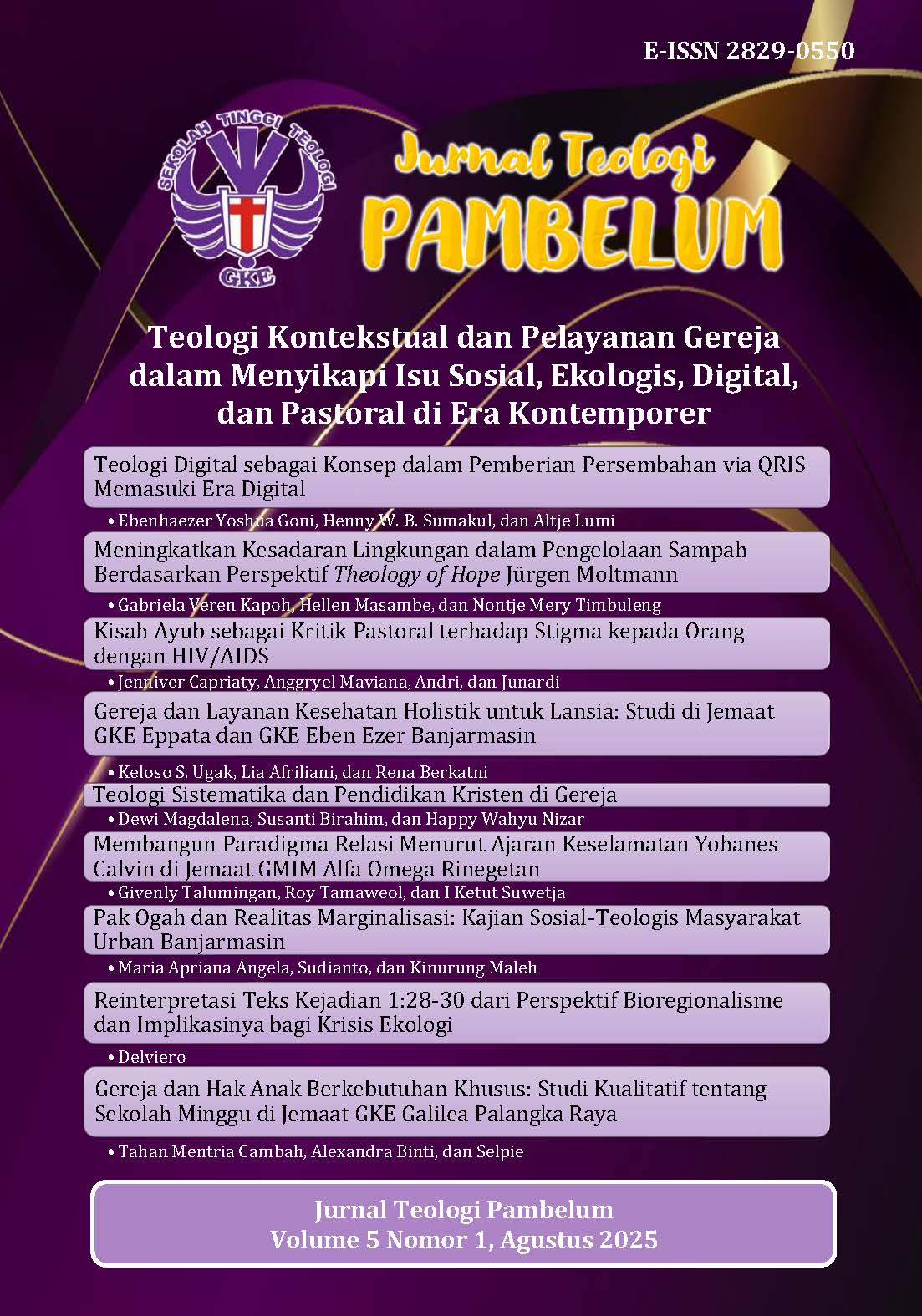
Contextual Theology and Church Ministry in Responding to Social, Ecological, Digital, and Pastoral Issues in the Contemporary Era
Thanks be to our Lord Jesus Christ, for His grace enables the publication of Pambelum Journal of Theology, Volume 5, Number 1 (August 2025). This edition presents nine articles that demonstrate how theology, deeply rooted in Scripture and tradition, remains responsive to the challenges of our contemporary context—social, ecological, digital, and pastoral.
The first article, “Digital Theology as a Concept in Offerings via QRIS in the Digital Era” by Ebenhaezer Yoshua Goni, Henny W. B. Sumakul, and Altje Lumi, reflects on how digital theology provides a theological foundation for offering practices through QRIS as an expression of faith in a digital society.
The second article, “Enhancing Environmental Awareness in Waste Management Based on Jürgen Moltmann’s Theology of Hope” by Gabriela Veren Kapoh, Hellen Masambe, and Nontje Mery Timbuleng, explores an eschatological perspective to encourage sustainable ecological practices within congregations.
The third article, “The Story of Job as a Pastoral Critique of Stigma toward People with HIV/AIDS” by Jenniver Capriaty, Anggryel Maviana, Andri, and Junardi, critiques retributive theology and proposes a correlational pastoral approach that rejects stigmatization of PLWHA.
The fourth article, “The Church and Holistic Health Care for the Elderly: A Study of the GKE Eppata and GKE Eben Ezer Congregations in Banjarmasin” by Keloso S. Ugak, Lia Afriliani, and Rena Berkatni, presents a study on how GKE congregations in Banjarmasin serve the elderly holistically—physically, mentally, socially, and spiritually.
The fifth article, “Systematic Theology and Christian Education in the Church” by Dewi Magdalena, Susanti Birahim, and Happy Wahyu Nizar, underlines the importance of systematic theology as the foundation of Christian education to nurture spiritually mature believers.
The sixth article, “Building a Relationship Paradigm According to John Calvin’s Teachings on Salvation in the GMIM Alfa Omega Rinegetan Congregation” by Givenly Talumingan, Roy Tamaweol, and I Ketut Suwetja, emphasizes the relational dimension of salvation as articulated in Calvin’s theology.
The seventh article, “Pak Ogah and the Reality of Marginalization: A Socio-Theological Study of Urban Banjarmasin” by Maria Apriana Angela, Sudianto, and Kinurung Maleh, examines the informal traffic workers known as “Pak Ogah” as a representation of marginalized urban communities, offering a Christian perspective of justice and compassion.
The eighth article, “Reinterpreting Genesis 1:28–30 from a Bioregionalism Perspective and Its Implications for the Ecological Crisis” by Delviero, provides an ecological reinterpretation of the creation mandate that stresses stewardship rather than exploitation of nature.
The ninth article, “Church and the Rights of Children with Special Needs: A Qualitative Study on Sunday School at GKE Galilea Palangka Raya” by Tahan Mentria Cambah, Alexandra Binti, and Selpie, highlights the importance of inclusive ministry for children with disabilities in sustaining the vitality of the church.
Together, these articles underline that Christian theology is not abstract but deeply contextual—engaging digital transformation, ecological crises, health and aging, Christian education, social marginalization, and disability inclusion. For this reason, the theme of this issue, “Contextual Theology and Church Ministry in Responding to Social, Ecological, Digital, and Pastoral Issues in the Contemporary Era,” encapsulates the commitment of this journal to contribute to theological scholarship and the life of the church.
We wish you insightful reading, and may these reflections inspire us to embody God’s Kingdom in today’s ever-changing world.
Warm regards, Dr. Idrus Sasirais, Editor-in-Chief, Pambelum Journal of Theology
Praise be to God Almighty for the publication of Jurnal Teologi Pambelum Volume 4, Issue 2, February 2025. In this edition, we present the theme Theology, Ethics, and Spirituality in Contemporary Contexts, which seeks to explore various theological dynamics in interaction with the evolving times. This theme highlights how theological, ethical, and spiritual understanding remains relevant in addressing the ever-changing social, cultural, and moral challenges.
The first article, titled "Ecological Spirituality Through Music: A Study on the Role of STT GKE Hymns in Enhancing Spirituality", authored by Ripaldi, Enta Malasinta Lantigimo, and Josephine Indah Sari, examines how hymns in the Kalimantan Evangelical Church Theological Seminary (STT GKE) serve as a means of enhancing spirituality, particularly in fostering ecological awareness among congregations.
The second article, "The Transformative Leadership of Jesus Christ: A Theological and Ecclesiological Review", written by Tomy Viktor Rampi Rawung, Yoas Tanugraha, and Arimurti Kriswibowo, explores the leadership model of Jesus Christ and how His transformative leadership principles can be applied in contemporary ecclesiastical and social contexts.
Next, the third article, titled "From Exclusivity to Inclusivity: The Shift in the Outpouring of the Spirit from the Old to the New Testament Based on Joel 2:28-29", by Alexzander Parlindungan Manalu and Kristina A. M. Panggabean, analyzes the shift in the concept of the outpouring of the Holy Spirit from the Old Testament to the New Testament and its implications for an inclusive theological understanding.
The fourth article, "The Importance of Shame: The Meaning of Adam and Eve's Fall in Preventing Scandals Among Christian Public Officials in Indonesia", authored by Andres Maurenis Putra, explores the role of shame in the Genesis 3 narrative as a moral foundation for Christian public officials in carrying out their duties with integrity.
The fifth article, titled "Ngitus Bali as Social Control in Murutuwu Village: A Sociological-Theological Study of Dayak Ma’anyan Christian Local Wisdom in Indonesia", written by Sudianto and Kinurung Maleh, discusses how the Ngitus Bali practice functions as a social control mechanism within the Dayak Ma’anyan Christian community and its relevance to social ethics.
Finally, the sixth article, "The Sin of ‘Envy’ in the Collection of Proverbs 3:31; 14:30; 23:17 and Its Implications for Gen-Z Social Interactions", by Irenza Artanauli Manurung, Clarita Hukum, Fredy Kapang, and Aska Aprilano Pattinaja, examines how the concept of envy in the Book of Proverbs can serve as an ethical reflection for the younger generation in facing social challenges in the digital era.
Through this edition, we hope that each article provides profound theological insights and encourages critical reflection in fostering a more ethical and spiritual life. We extend our gratitude to the authors, peer reviewers, and all parties who have contributed to the publication of this journal. May this journal serve as a valuable resource for the development of theology and the practice of Christian life.
With profound gratitude to God, we present the Pambelum Theological Journal Volume 4, Issue 1, August 2024. This edition features five research articles addressing various contextual theological topics relevant to the life of the church and society in Indonesia today.
The first article, authored by Ivana Aimee Djuharto, examines the role of women in the resurrection narrative according to Luke 24:1-12 using narrative analysis. The author finds that women, initially portrayed as marginal, were empowered by God to proclaim the Gospel of the Resurrection after undergoing a process of spiritual growth.
Next, Angely Daniel conducts a comparative study between Jacob's dream at Bethel (Genesis 28:10-22) and the simbuang batu symbol in the Rambu Solo' ritual of Toraja. The author observes a correlation in meaning between the stone pillar erected by Jacob as a symbol of God's presence and the simbuang batu as a representation of love and kinship in Torajan culture.
The third article, by Natalia Tosuli and Henri Sirangki, offers a theological exploration of the phenomenon of bubun to'saruran as a healing medium in the Pangrorean community of Toraja. The authors find that the community's belief in the healing efficacy of the bubun is not dualistic but remains centered on God as the ultimate source of healing.
Andry Saputra Ligawan, in his article, discusses the role of religious communities in addressing poverty from the perspective of liberation theology. The author emphasizes the importance of religion as an agent of change and a defender of the marginalized through active participation in poverty alleviation efforts.
The fifth article, by Jefri Andri Saputra, reconstructs the concept of the church's mission in the context of religious moderation, based on 1 Corinthians. The author concludes that the church's mission involves rejecting syncretism, internalizing religious identity, and fostering love as the spirit of building a solidaristic and missionary community.
The final article, written by May Linda Sari, Ripaldi, and Endy, explores the dialogue between the concept of the house in Banjar culture and the theological concept of Oikos in the New Testament. In Banjar culture, the house is not merely a dwelling place but reflects spiritual and social values, including social strata and religious principles. This study highlights that the foundation of a house, both physically and symbolically, embodies the meaning of life and resilience, aligning with Christ’s teaching in Matthew 7:24-27 about building a house on rock as a symbol of faith and obedience.
We hope that the articles in this edition enrich readers’ perspectives and stimulate constructive discussions among academics, practitioners, and church leaders. Happy reading and enjoying this issue!
Theology and local culture are two interrelated things. The culture and local wisdom possessed by each ethnic group contain noble values that are in line with Christian values. In this latest edition, the Pambelum Theology Journal raised the theme "Theology, Culture and Local Wisdom" as a framework for exploring the treasury of theological values contained in various cultures and local traditions.
The first paper was written by Sudianto, Kinurung Maleh and Ripaldi which examines the dialogue on the value of "Mira Pakat" in the Dayak Maanyan culture with the theological values contained in Philippians 2:1-7. Then followed by an article from Christo Antusias Davarto Siahaan analyzing opportunities for women's ministry based on Galatians 3:28 through the Epistolary approach.
Furthermore, Lia Afriliani, Enta Malasinta Lantigimo, Keloso S. Ugak conducted a theological study of the Piwara'an Tradition in the Context of the Dayak Maanyan at the GKE Hosana IV PIR Congregation. Followed by Jefri Andri Saputra et al proposing a new perspective on the role of women in the perspective of the "pairan dapo" concept and the story of Abigail. Lastly, the writing from Tahan Mentria Cambah, Retni Mulyani, and Alexandra Binti also enriches readers' insights with a study on the "mangenta" tradition and its theological meanings for the Christian congregation.
Through the diversity of perspectives in this publication, the editor hopes that the noble values contained in local wisdom can continue to be explored and enrich the theological understanding of Christians in the country, specifically in Kalimantan. Thus, the liberating gospel of Christ can be increasingly experienced by society and church members.
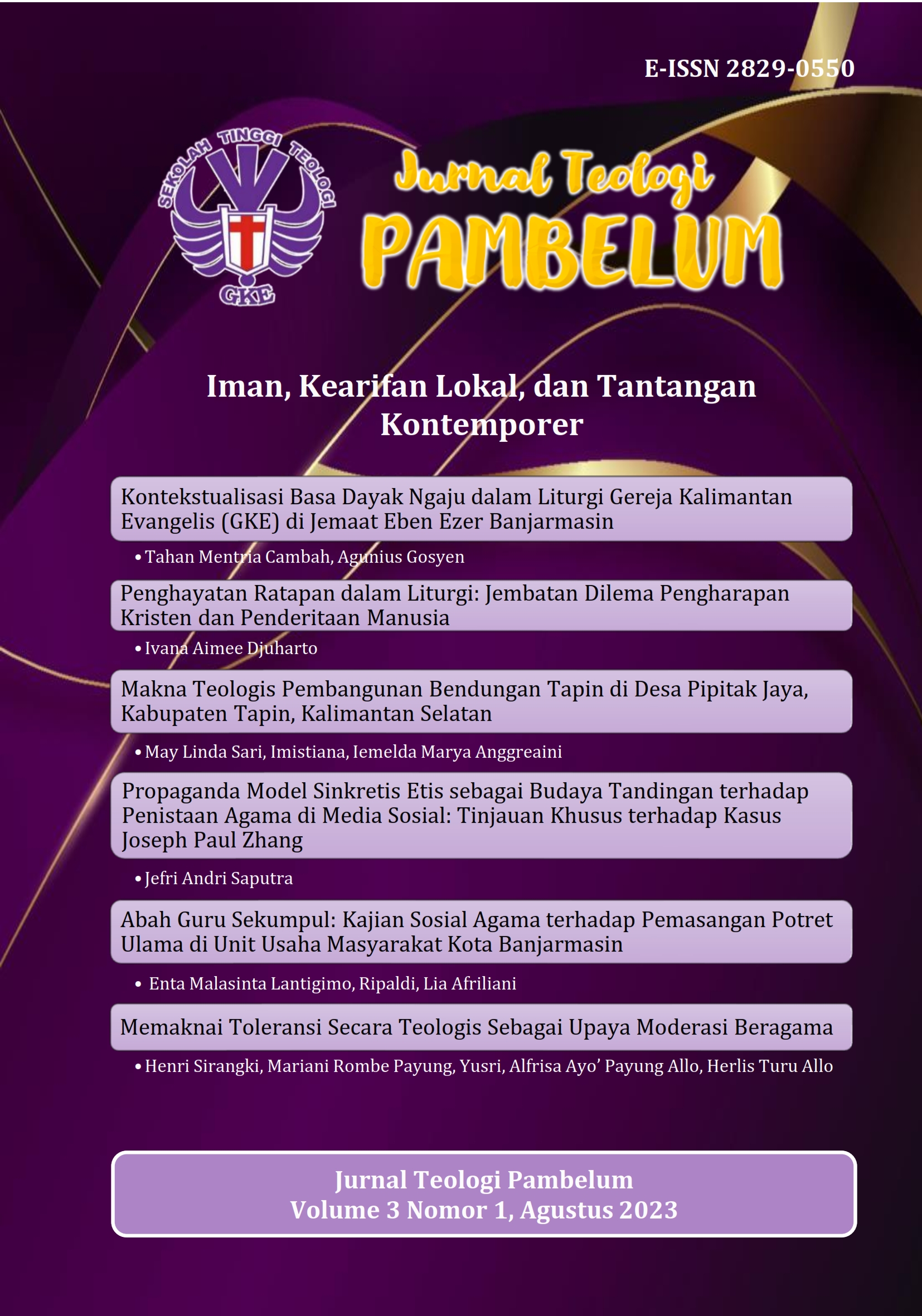
This publication centers around the overarching theme of "Faith, Local Wisdom, and Contemporary Challenges." The theme encapsulates a series of compelling articles that explore various theological perspectives concerning the phenomenon of Christianity within the realm of culture and its distinctive context. Together, they serve as windows that allow readers to apprehend the dynamics and complexities of the interaction between Christian beliefs and the heritage of local culture, religious convictions within a unique social context, and the role of Christian faith within contemporary dynamics.
Within this edition, there are six articles that have been published. The first article, titled "Basa Dayak Ngaju in GKE Liturgy: Contextualizing Christian Faith in Local Culture at the Eben Ezer Congregation in Banjarmasin," discusses the encounter between local cultural elements (Basa Dayak Ngaju) and Christian elements (Christian liturgy). The second article, "Christian Hope and Human Suffering in the Experience of Liturgical Lamentations: A Theological Analysis," highlights the dilemma inherent in the experience of lamentations within Christian liturgy.
The third article, "The Tapin Dam in Pipitak Jaya Village: Theological Significance in Local Infrastructure Development," explores the theological meanings contained within the construction of the Tapin Dam in Pipitak Jaya Village, Tapin Regency, South Kalimantan. The fourth article, titled "Ethical Syncretic Propaganda Model: Confrontation of Counter-Cultural and Religious Defense in the Era of Social Media," serves to underscore the ethical syncretic propaganda model approach as a response to the issue of religious defamation on social media.
The religious identity embedded in the portrayal of scholars, particularly the figure of Abah Guru Sekumpul in Banjarmasin City, possessing symbolic and social significance, is presented in an intriguing manner in the article titled "Abah Guru Sekumpul: A Socio-Religious Study of the Installation of Scholars' Portraits in the Community Enterprises of Banjarmasin City."
This edition concludes with an engaging and vital article titled "Tolerance as an Expression of Religious Moderation: Theological Analysis in Understanding the Framework of Interfaith Collaboration," which focuses on the interpretation of tolerance as a form of religious moderation through theological analysis. Enjoy your reading.
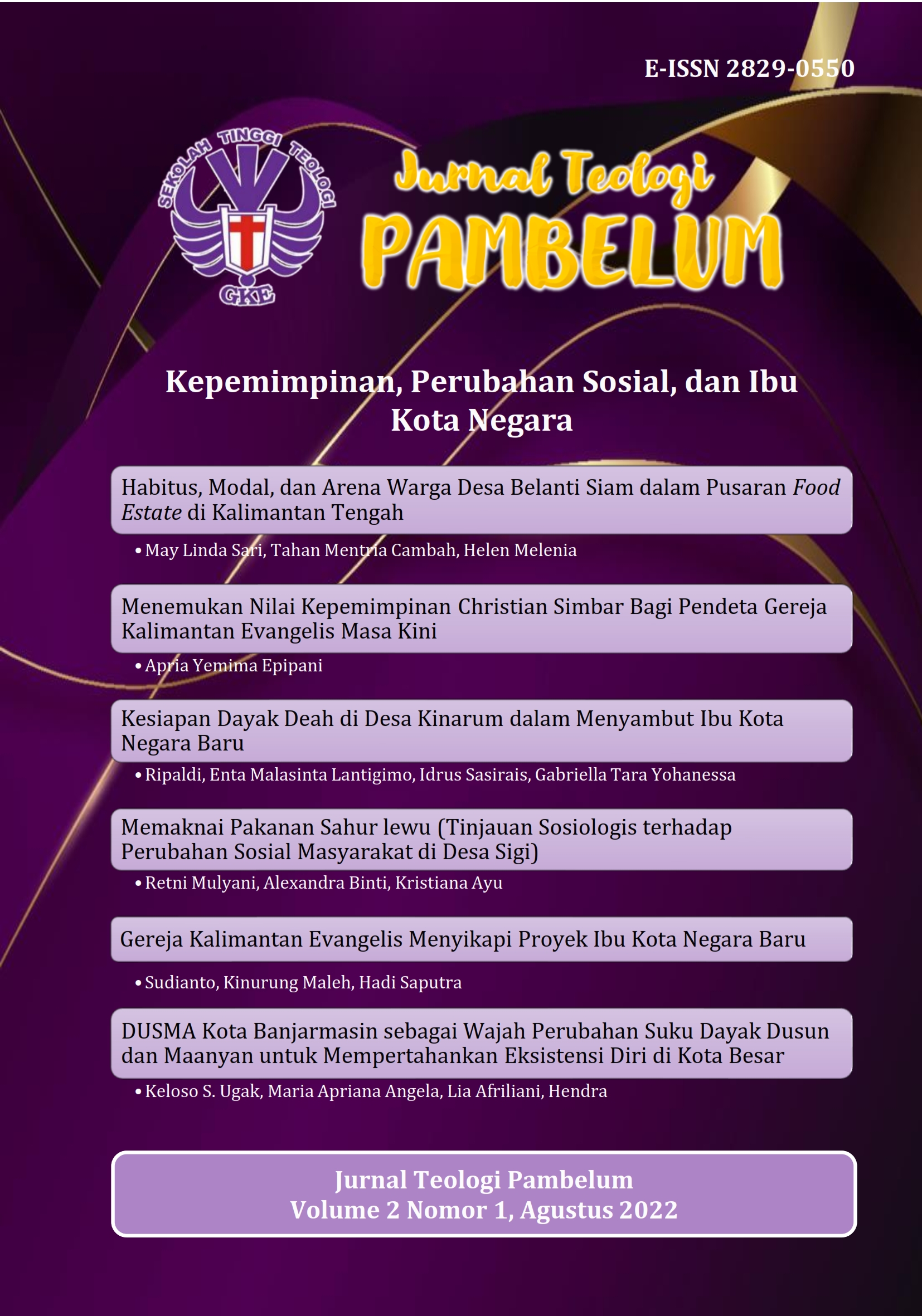
This edition raises the theme of "Theology in the Context of Social and Cultural Changes in Society". This edition provides a theological response to the dynamics of social and cultural changes in the context of Indonesia from the systematic theology, biblical studies, practical theology, and missiology perspectives. Social and cultural changes, including the relocation of the capital city of the Republic of Indonesia, demands for recognition of the rights of the LGBT community, demands for recognition of the rights of persons with disabilities, and so on, have a strong influence on the worldview and values held by the Indonesian society, including the Christian community. Therefore, theology plays a role in helping society to face these social and cultural changes so that society can respond and adapt to these changes correctly and well. Theology can help society to face these changes by maintaining important faith and traditional values while remaining open to beneficial social and cultural changes.
There are six articles published in this edition. The topic of disability theology is examined in an article titled "The Paradigm of the Congregation towards a Disabled Priest: A Disability Theology Study in the Context of the GKE Congregation in Selat Kuala Kapuas". The topic of LGBT is discussed in an article titled "Limited Grace?: Understanding the Acceptance of Late Teenagers from the Youth of the GKE Eppata Church Regarding the Lesbian and Homosexual Group from Romans 1:26-32 Text According to Criticism of Reader Response". The topic of dynamics related to the relocation of the new capital city of the Republic of Indonesia is discussed in an article titled "The Emergence of King Nansarunai in the Swirl of IKN". The topic of land is discussed in an article titled "Land Covenant: Examining the Concept of Covenant Regarding Land or Place from the Beginning of Creation in Genesis 1-2 and the Restoration of Creation in Revelation 21:1-2". The topic of contextual mission is discussed in an article titled "Postcolonial and Social Scientific Critique of Matthew 28:19: A Theological Construction in Mission".The topic of liberation theology is examined in an article titled "Postcolonial Approach to the Letter to Philemon: Rethinking Onesimus' Identity as a Runaway Slave".