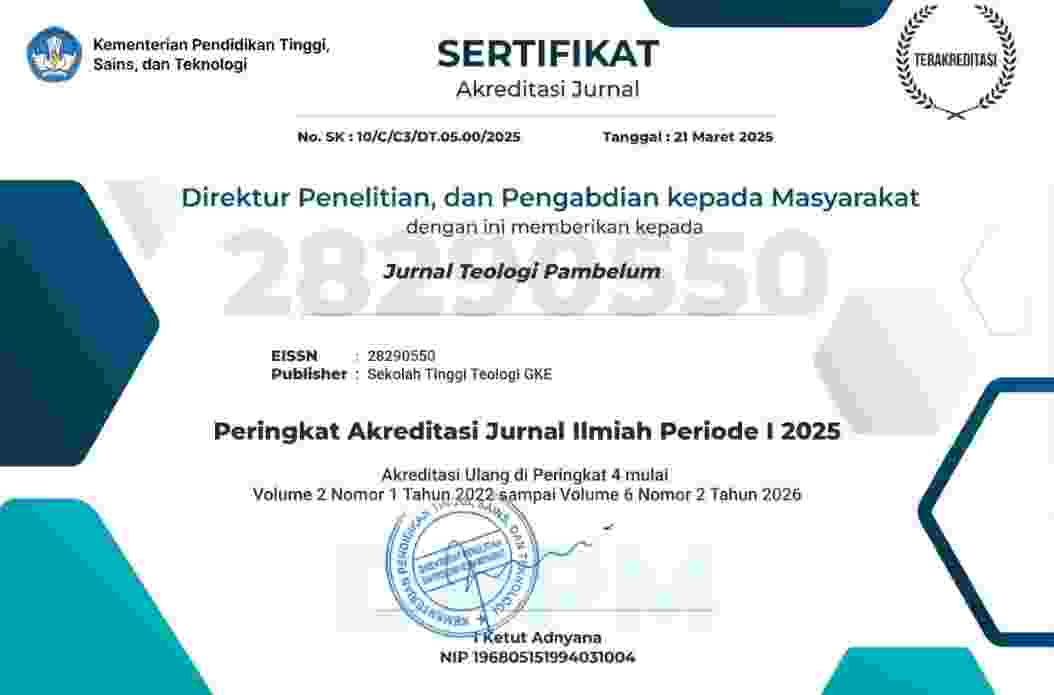
Acreditation Base on Surat Keputusan Direktur Jenderal Riset dan Pengembangan Nomor 10/C/C3/DT.05.00/2025
Jurnal Teologi Pambelum is committed to upholding high standards of publication ethics and academic integrity. Authors, editors, and reviewers are expected to adhere to the following ethical principles throughout the publication process.
Accuracy and Research Integrity. Authors must present research findings accurately and objectively, without fabrication, falsification, or inappropriate manipulation of data. Manuscripts must provide sufficient methodological details and references to support the verification and reproducibility of the research. Authors must follow the journal's Author Guidelines.
Originality and Plagiarism Prevention. Authors must ensure that their manuscripts are original and appropriately acknowledge the work of others. All sources must be cited correctly, and direct quotations must be clearly indicated. Authors are encouraged to check their manuscripts using plagiarism detection software before submission. The text similarity index must not exceed 20%. However, the similarity score alone does not determine whether plagiarism has occurred.
Exclusive Submission and Publication. Authors must not submit a manuscript that is under consideration by another journal or has already been published elsewhere. Duplicate or redundant publication may result in rejection, withdrawal, or retraction of the article, as appropriate.
Acknowledgment of Sources. Authors must properly acknowledge all sources of information, data, materials, and ideas used in their manuscripts through appropriate citations and references.
Authorship and Contributions. Only individuals who meet the journal's Authorship and Contributor Criteria may be listed as authors. All listed authors must have made meaningful scholarly contributions, approved the final version of the manuscript, and agreed to its submission.
Conflicts of Interest and Funding Disclosure. Authors must disclose any financial or non-financial conflicts of interest that could influence the research, the interpretation of its findings, or its publication. All relevant sources of research funding must also be acknowledged.
Correction of Errors. Authors must promptly notify the editor if they discover significant errors or inaccuracies in their published work or in a manuscript under review. Authors must cooperate with the journal to correct the publication record, including through corrections or retractions when necessary.
Responses to Editorial and Reviewer Comments. Authors are expected to respond to editorial and reviewer comments professionally and within the specified timeframe. Failure to respond or excessive delays may affect the editorial process and publication schedule.
Use of Artificial Intelligence (AI). Authors must comply with the journal's AI policy. They remain fully responsible for the accuracy, originality, integrity, and proper attribution of all content submitted for publication. AI tools must not be listed as authors.
Initial Editorial Assessment. Editors assess submitted manuscripts for compliance with the journal's Author Guidelines, relevance to the journal's focus and scope, originality, and basic scholarly quality. Manuscripts that meet the initial requirements are forwarded for peer review, normally within 1–7 days, depending on the editorial workload and the volume of submissions.
Reviewer Selection and Peer-Review Integrity. Editors select qualified reviewers based on their expertise and the subject matter of the manuscript. The journal follows its established peer-review policy and takes appropriate measures to protect the confidentiality of authors' and reviewers' identities. Editors must avoid appointing reviewers who have relevant conflicts of interest.
Fair and Objective Decisions. Editorial decisions must be based on the manuscript's scholarly quality, originality, relevance, and contribution to the field, rather than the authors' personal characteristics, institutional affiliations, or other irrelevant considerations. Editors may reject manuscripts that fall outside the journal's focus and scope.
Confidentiality. Editors must maintain the confidentiality of submitted manuscripts and related correspondence. Manuscript content must not be disclosed to unauthorized individuals or used for personal advantage. Editors must not upload or enter unpublished manuscripts or related confidential information into artificial intelligence (AI) tools or services that do not guarantee confidentiality and data protection. The use of AI in the editorial process must be handled cautiously, in accordance with the journal's policies, and must not replace the editor's professional judgment or responsibility. Any potential breach of confidentiality must be addressed appropriately.
Conflicts of Interest and Editorial Independence. Editors must not use unpublished material from submitted manuscripts without the authors' written permission. Editors who have conflicts of interest must disclose them and, where necessary, recuse themselves from the relevant editorial decision-making process.
Editorial Decisions and Accountability. Based on reviewers' reports and their own editorial assessments, editors may accept, reject, or request revisions to manuscripts. Decisions must take into account scholarly validity, relevance to the journal's readership, editorial policies, ethical standards, and applicable laws and regulations. Editors may consult other editors or qualified experts when necessary and are responsible for maintaining the quality and integrity of the journal's published content.
Confidentiality and Peer-Review Integrity. Reviewers must treat manuscripts received for review as confidential documents. They must not share, discuss, or disclose manuscript content to anyone other than the responsible editor without prior authorization. Reviewers must not upload or enter manuscripts under review or related confidential information into artificial intelligence (AI) tools or services that do not guarantee confidentiality and data protection. Any use of AI to assist with the review process must comply with thejournal's AI policy, preserve manuscript confidentiality, and not replace the reviewer's critical judgment or professional responsibility. Reviewers must also comply with the journal's peer-review policy.
Objective and Systematic Evaluation. Reviewers must evaluate manuscripts fairly, constructively, and objectively using the journal's review form or evaluation criteria. Their assessments must be supported by clear reasoning and relevant scholarly evidence.
Assessment of Scholarly Quality. Reviewers should evaluate the coherence, originality, theoretical or conceptual framework, methodology, analysis, interpretation, conclusions, and references of a manuscript, as applicable. They should also identify weaknesses, unsupported claims, methodological concerns, and relevant literature that has not been cited.
Constructive Feedback and Research Integrity. Reviewers must provide specific and constructive recommendations to help authors improve their manuscripts. They must inform the editor of suspected plagiarism, duplicate publication, data fabrication, data falsification, or other forms of research misconduct. Reviewers must respect the authors' intellectual contributions and avoid imposing personal preferences unrelated to scholarly quality.
Conflicts of Interest. Reviewers must disclose any actual or potential conflicts of interest that could compromise their impartiality. If a conflict cannot be appropriately managed, they must decline the review assignment.
Timeliness. Reviewers must complete their evaluations within the timeframe specified by the editor. If they are unable to meet the deadline, they must promptly inform the editor so that an extension or the appointment of an alternative reviewer can be considered. The average review period is approximately 14–21 days, depending on reviewer availability and the complexity of the manuscript.




Beriman, Berilmu, dan Berdampak
SEKOLAH TINGGI TEOLOGI GEREJA KALIMANTAN EVANGELIS
Jl. D.I. Panjaitan No. 11 Banjarmasin, Kalimantan Selatan, Indonesia 70114
Website: http://jurnal.stt-gke.ac.id/index.php/pambelumjtp
Email: ojspambelum@gmail.com
 This work is licensed under a Lisensi Creative Commons Atribusi 4.0 Internasional
