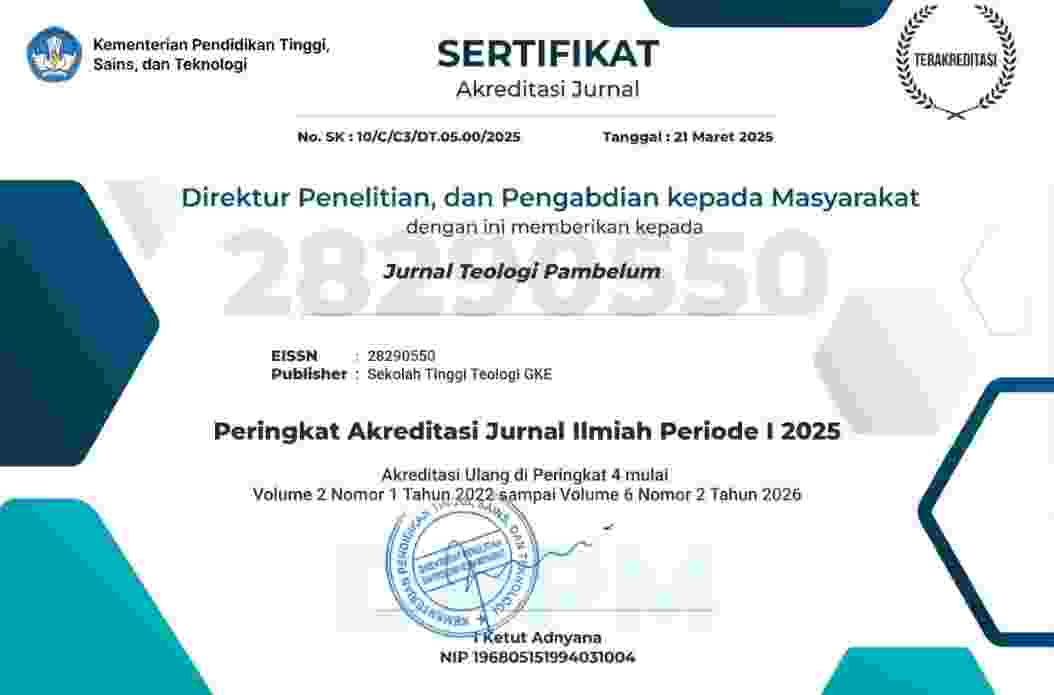
Acreditation Base on Surat Keputusan Direktur Jenderal Riset dan Pengembangan Nomor 10/C/C3/DT.05.00/2025
Articles submitted to the Jurnal Teologi Pambelum must be original scholarly works that have not been previously published and are not currently under review or submitted to another journal. Articles must be written in Indonesian or English and may take the form of research findings or scholarly studies relevant to the focus and scope of the Jurnal Teologi Pambelum.
Font and Paper Size
The font used in the article is Times New Roman, size 12pt (except for the article title). The paper size is A4, with a 2 cm header, 2 cm footer, 3 cm top margin, 3 cm bottom margin, 4 cm left margin, and 3 cm right margin, without page numbers.
Citation Style
Citations and references must follow the American Psychological Association (APA) 7th edition style. Use the Mendeley or Zotero applications.
Manuscript Length
The manuscript length must be between 5,000 and 7,000 words, including the title through the reference list.
Article Title
The title must be no more than 14 words, concise, to the point, and accurately represent the content, without repetition of words, and written in Times New Roman 14 pt.
Author Name, Affiliation, and Correspondence Address
The author’s name is written in Times New Roman, 12 pt, bold. Affiliations and the corresponding author’s address should be written in Times New Roman, 11 pt, bold. The author’s full name, without academic titles, should be in bold. If there is more than one author, the names of the second and subsequent authors should be separated by commas (,). A maximum of 4 authors per article is allowed.
Abstract
For articles written in Indonesian, the abstract must be written in both English and Indonesian. For articles written in English, the abstract need only be in English. The English abstract must be written in italics. The abstract must be written in 11-point Times New Roman font, single-spaced, with a maximum of 200 words. The abstract should briefly outline the problem, objectives, methods, results, and conclusions.
Keywords
Keywords are a list of words found in the abstract that reflect the research, separated by semicolons (;), with a maximum of 5 words.
Introduction
The introduction includes the background, literature review (state of the art), significance of the topic, problem formulation, and objectives. It is justified and formatted in Times New Roman 12pt font with 1.15 line spacing.
Method
Describe the methods used to address the research problem, such as qualitative methods, quantitative methods, literature review methods, interpretive methods, or other methods. Also describe the sources and validity of the data, the analysis process, and the presentation of the data. The text should be justified with a 12-point Times New Roman font and 1.15 line spacing.
Findings and Discussion
This section is written using Times New Roman, 12pt, with 1.15 line spacing. This section presents the research findings and their discussion in a descriptive, systematic, and argumentative manner. The research results must be supported by adequate data in accordance with the approach and type of research used. The discussion aims to address the research questions, interpret the results, integrate them with the literature, and develop or modify theories. The research results and discussion must address the research questions or hypotheses stated in the introduction. They may be presented in several subsections. Authors may present their findings descriptively, in tables, graphs, or other forms of data presentation, depending on the research approach used. If necessary, subheadings may be used to clarify the flow of the argument and discussion, as shown below:
Finding and Discussion
If there are research findings that need to be elaborated on or explained in detail.
Subtopics
The presentation of subtopics should be tailored to the type of research and should be presented in narrative form, not numerically.
Implications
Present theoretical and practical implications in narrative form. Written descriptively in Times New Roman, 12pt, 1.15 line spacing.
Recommendations for Further Research
Present recommendations for further research. Written descriptively in Times New Roman, 12pt, 1.15 line spacing.
Conclusion
The conclusion addresses the research questions. Recommendations should refer to the results in the form of practical actions, specifying for whom they are intended and their purpose. They should be presented in essay form, not numerically. Written in Times New Roman 12pt font, 1.15 line spacing.
AI Use Disclosure (If Applicable)
A disclosure regarding the use of AI must be included in the “Statement on the Use of AI” section at the end of the manuscript, before the reference list. However, authors who do not use AI tools beyond routine checks for spelling, punctuation, and basic grammar are not required to include an AI Usage Statement. Example of an AI usage statement: The author used [name of tool] to assist with [describe the purpose of use, e.g., language editing and initial organization of ideas]. All results obtained have been critically reviewed and revised by the author. The author assumes full responsibility for the accuracy, originality, academic integrity, and content of the final manuscript.
References
All sources cited or referenced in the article must be included in the Reference List. Conversely, sources not cited or used in the article’s discussion should not be included in the Reference List. The References list is arranged in alphabetical order by the authors’ last names and follows the American Psychological Association (APA) 7th edition citation style. The References list should be generated using a reference management application, such as Mendeley or Zotero. Use Times New Roman font, 12pt, with 1.15 line spacing.
Complete guidelines for writing journal articles can be found in the Journal Template.




Beriman, Berilmu, dan Berdampak
SEKOLAH TINGGI TEOLOGI GEREJA KALIMANTAN EVANGELIS
Jl. D.I. Panjaitan No. 11 Banjarmasin, Kalimantan Selatan, Indonesia 70114
Website: http://jurnal.stt-gke.ac.id/index.php/pambelumjtp
Email: ojspambelum@gmail.com
 This work is licensed under a Lisensi Creative Commons Atribusi 4.0 Internasional
