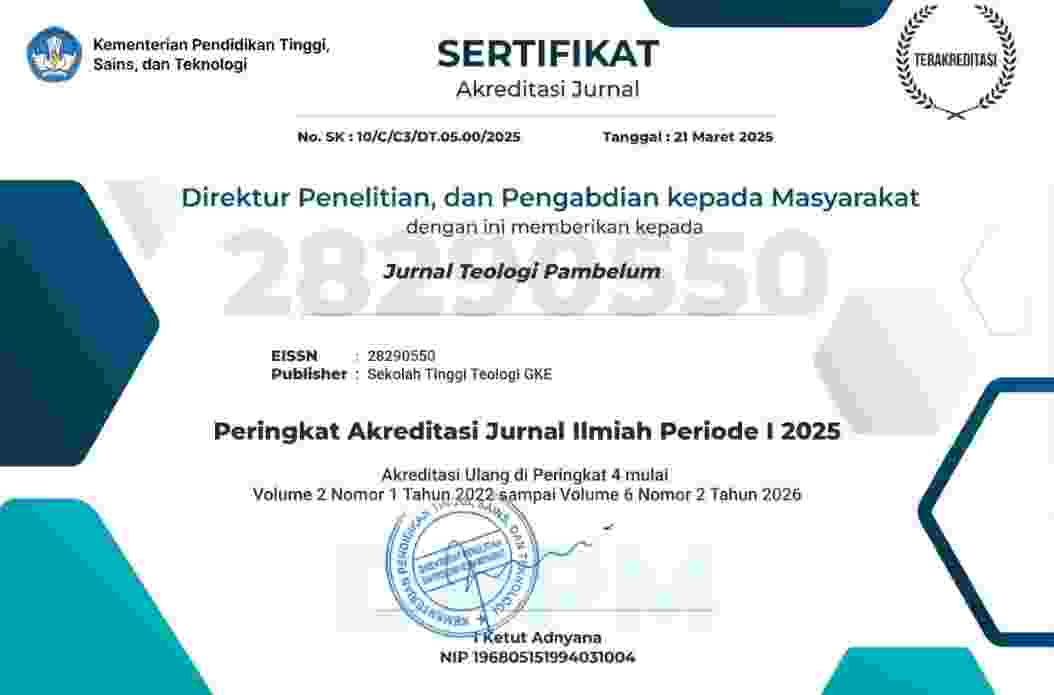
Acreditation Base on Surat Keputusan Direktur Jenderal Riset dan Pengembangan Nomor 10/C/C3/DT.05.00/2025
Jurnal Teologi Pambelum (JTP) is committed to upholding the integrity of research and scholarly publishing. The journal takes all allegations of research and publication ethics misconduct seriously and addresses them fairly, objectively, and proportionately, whether they are raised before or after an article has been published.
This policy is informed by the principles and guidance of the Committee on Publication Ethics (COPE). The submission of an allegation does not, in itself, establish that misconduct has occurred. Each report will be assessed based on the available information and evidence, while respecting the right of all parties to provide an explanation.
Allegations of misconduct that may be addressed include, but are not limited to, plagiarism, redundant publication, data fabrication or falsification, authorship violations, undisclosed conflicts of interest, manipulation of the peer-review process, research ethics violations, citation manipulation, and misuse of artificial intelligence (AI) in ways that violate the journal's policies.
Reported allegations will be handled according to the nature of the concern and the relevant JTP policies, including the Plagiarism and Research Integrity Policy, Conflict of Interest Policy, Authorship Policy, AI Use Policy, and Publication Ethics Policy.
Anyone, including authors, reviewers, editors, readers, and members of the public, may report suspected research or publication ethics misconduct to the JTP editorial team through the journal's official communication channels.
Please send your report by email to ojspambelum@gmail.com, using the subject line Integrity Concern: [Article or Submission Identifier].
Reports should include the following information:
Anonymous reports may be considered if the information provided is sufficiently specific and can be verified. JTP may request clarification or additional evidence when necessary to assess the report.
The editorial team will conduct an initial assessment of each report to determine whether the matter falls within the scope of the journal's policies, whether the information provided is sufficient for further consideration, and whether additional clarification is needed.
Reports will be assessed based on their substance and the available evidence, rather than the status or relationship of the reporting party to the person concerned. Reports that lack sufficient grounds may be closed but may be reconsidered if relevant new evidence becomes available.
If a report is deemed suitable for further consideration, JTP will conduct a proportionate preliminary examination to understand the concern and safeguard the integrity of the publication process. This examination does not replace a formal investigation that falls within the responsibility of the relevant institution or competent authority.
The person concerned will generally be given a reasonable opportunity to provide an explanation and submit relevant evidence. JTP will consider the response alongside the available evidence before determining any editorial action.
Where necessary, the journal may:
A temporary suspension of the editorial process during an examination does not, in itself, constitute a finding of misconduct.
Actions taken by JTP will depend on the nature, severity, available evidence, impact, and stage of publication at which the alleged misconduct is identified.
For unpublished manuscripts, actions may include:
For published articles, actions may include:
Corrections and retractions are intended to preserve the reliability of the scholarly record, rather than merely to punish authors. All actions will be taken in accordance with JTP's applicable publication policies.
JTP will maintain the confidentiality of information and the identities of the parties involved to the extent possible, while providing all parties with a reasonable opportunity to explain their positions. Every report will be handled objectively and without prejudice toward the person concerned.
Reports that are knowingly false or submitted maliciously may be treated as a separate ethical concern.
Jurnal Teologi Pambelum is committed to handling all allegations of misconduct fairly, objectively, transparently, and consistently with the principles of scholarly publication ethics. JTP will take reasonable steps to protect the integrity of the scholarly record and ensure that published articles meet standards of honesty, accountability, and academic responsibility.
This policy should be read in conjunction with JTP's other publication ethics policies, particularly the Plagiarism and Research Integrity Policy, Conflict of Interest Policy, Authorship Policy, AI Use Policy, and Correction and Retraction Policy.




Beriman, Berilmu, dan Berdampak
SEKOLAH TINGGI TEOLOGI GEREJA KALIMANTAN EVANGELIS
Jl. D.I. Panjaitan No. 11 Banjarmasin, Kalimantan Selatan, Indonesia 70114
Website: http://jurnal.stt-gke.ac.id/index.php/pambelumjtp
Email: ojspambelum@gmail.com
 This work is licensed under a Lisensi Creative Commons Atribusi 4.0 Internasional
