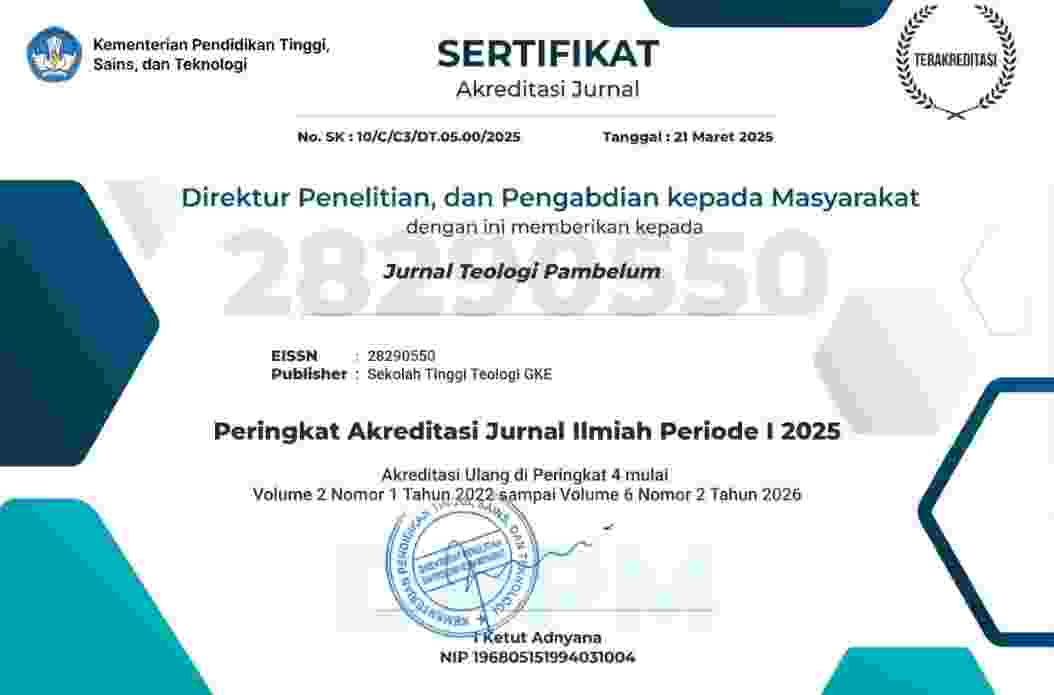
Acreditation Base on Surat Keputusan Direktur Jenderal Riset dan Pengembangan Nomor 10/C/C3/DT.05.00/2025
Jurnal Teologi Pambelum (JTP) is committed to maintaining the accuracy, integrity, and reliability of the scholarly record. JTP addresses all reports concerning errors, inaccuracies, or integrity issues in published articles fairly, objectively, and proportionately. This policy is informed by the principles and guidance of the Committee on Publication Ethics (COPE) regarding corrections and retractions.
A correction is issued when a published article contains an error or omission that needs to be addressed, but its main findings and conclusions remain generally reliable. Corrections may include errors in author names or affiliations, funding or conflict of interest statements, references, tables, figures, or other information that affects readers' understanding of the article.
Authors or readers may submit correction requests to the JTP editorial team by providing the article details, a description of the error, the proposed correction, and relevant supporting evidence. The editor will assess the request and may seek clarification from the authors or other relevant parties.
Approved corrections will be published through an official notice explaining the error and the corresponding amendment, with a link to the original article. Substantive changes must not be made silently without notifying readers.
JTP may publish an expression of concern when serious issues regarding the reliability or integrity of an article remain unresolved, for example, because an investigation is ongoing or the available evidence is insufficient to reach a final decision.
An expression of concern informs readers that an issue is under examination without implying that the alleged misconduct has been established. The notice will be linked to the relevant article and may be updated or followed by further action once the examination has been completed.
A retraction is issued when sufficient evidence indicates that an article is no longer reliable or that serious misconduct has compromised the integrity of the publication. The retraction may include:
Retraction may result from either ethical misconduct or unintentional errors when such errors render the research findings unreliable. Its purpose is to correct the scholarly record, not merely to punish authors.
The decision to retract an article will be made by the authorized editor after assessing the evidence and considering the authors' explanations. Authors' consent is not an absolute requirement when the available evidence justifies retraction.
A retraction notice must explain the reasons for the retraction, identify the affected article, and be permanently linked to the original article. Retracted articles will generally remain accessible, clearly marked as retracted
Each correction request or report concerning a published article will be assessed by the editorial team based on the available information and evidence. Where necessary, JTP may request explanations from the authors, consult independent experts, or coordinate with the relevant institutions.
Authors will be given a reasonable opportunity to respond to the reported concerns. If suspected ethical misconduct is identified, the matter will also be handled in accordance with JTP's Allegations of Misconduct Policy.
JTP will determine the appropriate action based on the nature of the issue, its severity, the available evidence, and its impact on the reliability of the article. Not every error warrants retraction; a correction may be sufficient when the article's main findings remain reliable.
Requests for corrections or reports concerning suspected errors, inaccuracies, or integrity issues in published articles may be submitted to the JTP editorial team by email at ojspambelum@gmail.com. Reporters are encouraged to provide the article title, publication details, a clear description of the concern, and relevant supporting evidence to assist the assessment process.
Authors are responsible for promptly notifying JTP if they discover significant errors in their published articles and for cooperating with the assessment and correction process.
JTP will make reasonable efforts to ensure that corrections, expressions of concern, and retraction notices are readily accessible and linked to the relevant articles. Bibliographic information and publication status will be updated where necessary and feasible.
Through this policy, Jurnal Teologi Pambelum is committed to maintaining transparency, accountability, and the reliability of the scholarly record, and to ensuring that all editorial actions are taken fairly, objectively, and in accordance with the principles of scholarly publication ethics.




Beriman, Berilmu, dan Berdampak
SEKOLAH TINGGI TEOLOGI GEREJA KALIMANTAN EVANGELIS
Jl. D.I. Panjaitan No. 11 Banjarmasin, Kalimantan Selatan, Indonesia 70114
Website: http://jurnal.stt-gke.ac.id/index.php/pambelumjtp
Email: ojspambelum@gmail.com
 This work is licensed under a Lisensi Creative Commons Atribusi 4.0 Internasional
