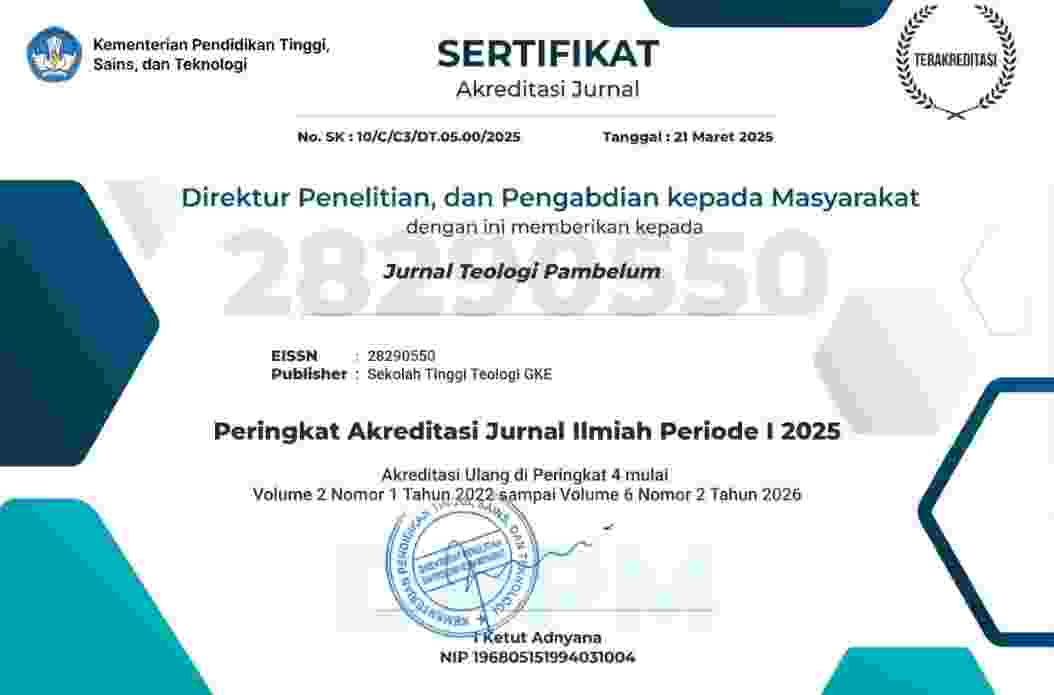
Acreditation Base on Surat Keputusan Direktur Jenderal Riset dan Pengembangan Nomor 10/C/C3/DT.05.00/2025
Jurnal Teologi Pambelum (JTP) is committed to maintaining transparency, impartiality, and integrity throughout the scholarly publishing process. This policy outlines how the journal identifies, discloses, and manages conflicts of interest that may affect the conduct, reporting, review, or publication of research. It is informed by the principles and guidance of the Committee on Publication Ethics (COPE).
A conflict of interest, also referred to as a competing interest, is any relationship, circumstance, or activity that could influence, or reasonably be perceived to influence, an individual's objectivity and impartiality in conducting research, preparing a manuscript, reviewing a submission, or making editorial decisions. The existence of a conflict of interest does not necessarily indicate misconduct. Disclosure enables the journal to assess the circumstances transparently and take appropriate measures to safeguard the integrity of the publication process.
Conflicts of interest may include, but are not limited to, the following:
Ordinary scholarly disagreements or differences in theological interpretation do not, in themselves, constitute conflicts of interest that require an individual to withdraw from the review or decision-making process.
All authors must disclose any actual, potential, or perceived conflicts of interest relevant to their submitted manuscript. The corresponding author is responsible for ensuring that the declaration accurately reflects the interests of all co-authors.
Authors must also disclose all sources of funding and, where applicable, explain the role of funders in the research process and manuscript preparation. A funding statement does not replace a conflict of interest declaration; both statements must be provided separately where applicable.
If no conflicts of interest exist, authors must include the following statement: “The authors declare that they have no conflicts of interest.”
If a relevant conflict exists, authors must describe it clearly and accurately. The editorial team will assess the disclosure to determine whether further action is necessary.
Editors must disclose any relevant conflicts of interest and must not handle manuscripts when their impartiality may be compromised. This includes manuscripts authored or co-authored by the editor, as well as manuscripts involving close personal, professional, or institutional relationships.
In such cases, the manuscript must be assigned to an independent editor who will oversee the review process and editorial decision-making without the involvement of the conflicted editor.
Reviewers must disclose any actual, potential, or perceived conflicts of interest before accepting an invitation to review a manuscript. They must decline the invitation if the conflict could prevent them from providing an objective and impartial assessment. Reviewers must promptly inform the editor if a conflict of interest becomes apparent during the review process. The editor will determine whether the reviewer may continue or should be replaced by an alternative reviewer.
The editorial team is responsible for assessing disclosed conflicts of interest and determining appropriate measures to protect the integrity of the publication process. Depending on the circumstances, these measures may include requesting additional information, publishing a conflict of interest disclosure, appointing an independent editor or reviewer, or taking other appropriate action.
If an undisclosed or inadequately disclosed conflict of interest is identified after submission or publication, the journal will assess the circumstances and their potential impact on the integrity of the scholarly record. Where warranted, the journal may issue a correction, publish an expression of concern, or retract the article in accordance with its publication ethics policies.
Failure to disclose a relevant conflict of interest may result in further editorial action, depending on the nature and severity of the case.
Jurnal Teologi Pambelum is committed to ensuring that editorial and publication decisions are based on scholarly merit, relevance, and manuscript quality, rather than on undisclosed competing interests. All authors, reviewers, and editors are expected to cooperate with the journal in identifying and managing conflicts of interest to maintain public trust and uphold the integrity of theological scholarship.




Beriman, Berilmu, dan Berdampak
SEKOLAH TINGGI TEOLOGI GEREJA KALIMANTAN EVANGELIS
Jl. D.I. Panjaitan No. 11 Banjarmasin, Kalimantan Selatan, Indonesia 70114
Website: http://jurnal.stt-gke.ac.id/index.php/pambelumjtp
Email: ojspambelum@gmail.com
 This work is licensed under a Lisensi Creative Commons Atribusi 4.0 Internasional
